
In March 2026, LSC Psychology hosted a professional development event with international expert Dr Caroline Logan. To explore upcoming training opportunities, visit our PD Events page or contact training@lscpsych.com.au.
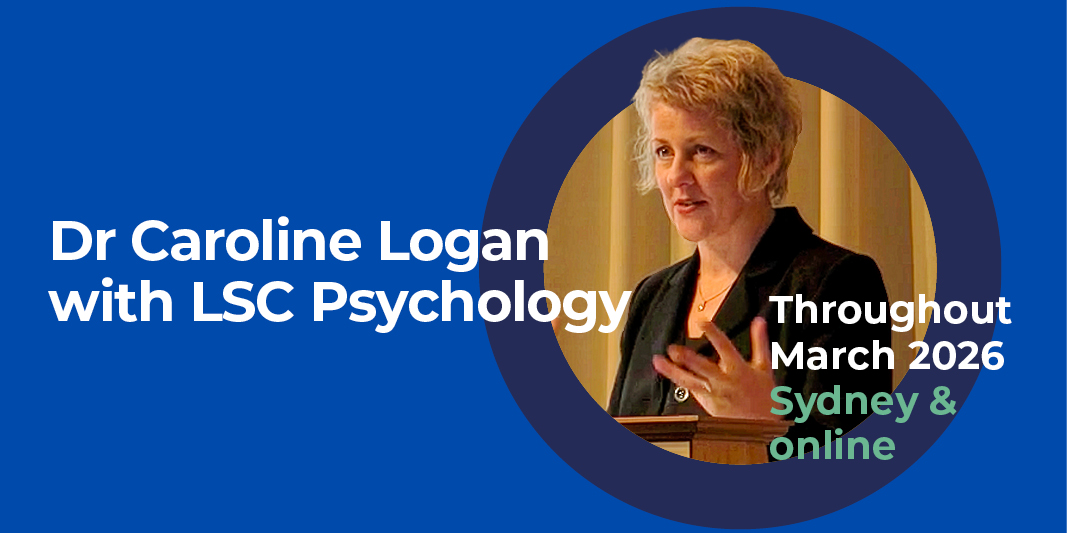
A rare opportunity to learn directly from one of the world’s leading experts in forensic and clinical risk assessment
9 Mar – 11 Mar 2026
1. Personality disorder assessment using the Structured Clinical Interview for DSM-5 Alternative Model of Personality Disorder (SCID-5-AMPD) Modules I to III: Essential skills for psychological practitioners working with high-risk clients
Duration 3 days Format In-person @ Sydney Masonic Centre
Personality disorders and personality problems, more generally, are a challenge to assess. Such conditions are often flagged in people who have had difficult, if not traumatic lives (e.g., they are victims of abuse or neglect), and/or who live in difficult circumstances (e.g., abusive intimate relationships, prison settings). Also, other clinical conditions can sometimes present similarly to personality problems, such as autism and chronic post-traumatic stress disorder, and be a challenge to disentangle. Semi-structured clinical interviews, more than self-report questionnaires, are thought to give practitioners – and clients – the best opportunity to establish personality structure, any inherent personality difficulties, the extent of co-morbidity, and the relevance of personality problems to risk.
The AMPD was first published in section III of DSM-5 and has been subject to much research. The SCID-5-AMPD Modules I to III operationalise the evaluation of the alternative model through three semi-structured clinical interviews. Module I is the Level of Personality Functioning Scale (LPFS), a semi-structured clinical interview for assessing the severity of personality problems across the core realms of self and interpersonal functioning. The LPFS is closely aligned to the severity indicators described in the revised personality disorder criteria published in the WHO’s 11th edition of the International Classification of Diseases (ICD-11). Module II is a semi-structured clinical interview for assessing problematic personality traits (negative affectivity, detachment, psychoticism, antagonism and disinhibition). Module III is a semi-structured clinical interview for the assessment of each of the six personality disorders in the AMPD: antisocial, narcissistic, borderline, avoidant, obsessive-compulsive and schizotypal. In a clinical assessment, Modules may be administered as stand-alone assessments, or all three modules may be administered together and in order, I through III, as determined by the nature of the evaluation required.
This intensive 3-day in-person training course will examine the background to personality disorder assessment and the AMPD, its evidence base and the parallels with the assessment of personality problems using the ICD-11. It will then examine in detail each of the three modules, how they are structured and implemented in practice, and how assessment findings are determined. The course will also examine how those findings are prepared in written communications with others, including the Courts, either as standalone assessment findings about the nature and degree of personality problems or as part of a broader assessment of risk.
This course is suitable for qualified practitioners with experience of working with people with personality problems who wish to develop their current practice to include established assessments that involve semi-structured clinical interviewing. This course will be relevant to practitioners working in both forensic and family court settings with clients at risk of harm to others or themselves.
Intended audience
Qualified psychological practitioners (mainly clinical and forensic psychologists) and psychiatrists. Trainees may attend, but their practice using the SCID-5-AMPD module interviews must be supervised by an experienced and SCID-5-AMPD-trained practitioner.
Learning objectives
12-13 Mar 2026
2. Personality and its relevance to the assessment and management of insider risk
Duration 2 days Format Online
This two-day online workshop will focus on the comprehensive assessment of personality through a combination of psychometric assessment and clinical interview and the relevance of observations to the assessment of insider risk.
The workshop will begin with a review of key issues in personality and insider risk. Key issues will include the nature of both personality and insider risk and their putative links, personality traits relevant to insider risk, and the relationships between personality and other risk and resilience factors in sensitive work settings. Three detailed case studies relating to insider risk scenarios will be introduced, which will be drawn on throughout the remainder of the training.
The next part of the workshop will examine the assessment of personality. Different options for assessment (e.g., self-report, unstructured, structured and semi-structured clinical interviews, structured observations by others, etc) will be examined to demonstrate the strengths and weaknesses of each approach, how they may usefully be combined, and the limitations of relying on any single or specific combination of approaches. Examples of each will be discussed to illustrate notable points. The practicalities of assessing personality in the context of a wider assessment of risk will then be explored.
Differentiating personality traits from conditions that may present superficially in similar ways will then be considered. This is an essential topic of discussion. The case studies will be used to illustrate a set of guiding principles for determining the basis for deciding what condition takes precedence and why – and managing the difficulty of being unable to be sure, despite the rigour of the assessment methods used, on a final determination of risk.
By far the most effective way of assessing personality is via clinical interview. Therefore, the remainder of the course will focus on interviewing skills and their application through several different semi-structured interview formats. The organisation of such an interview and a discussion with the client about their personality characteristics in relation to insider risk potential will be examined in detail. The case studies will be relied on once again to aid advanced reflections on practice.
This course is intended for qualified practitioners working in – or with or on behalf of – organisations that make significant demands of their employees, practitioners whose job it is to understand as much about the resilience of employees as their potential vulnerabilities, and who are dedicated to the use of psychometric assessments as an adjunct to advanced clinical skills to do so in practical, informative and sensitive ways.
Intended audience
Psychological practitioners who work in, with or on behalf of organisations whose primary asset is their employees, whose honesty, integrity and loyalty must be assured.
Learning objectives
16 March 2026:
3. Clinical interviewing skills for psychological practitioners working with very complex clients
Duration 1 day Format In-person @ Sydney Masonic Centre
Psychological practitioners require skills in the direct – that is, face-to-face – assessment of people who may be ambivalent, if not reluctant, to engage in such a process. For example, they may be known or suspected perpetrators of violence or sexually harmful behaviour or pose risks in other ways that they may be reluctant to discuss openly. Psychological practitioners also require skills in indirect assessment, such as when a person refuses to engage, yet an evaluation is still required (e.g., for the assessment of self-directed harm) or when there are sound clinical reasons not to engage directly with the client, and third parties must be consulted. Thus, the principal skills required for practitioners are those for interviewing in direct assessments and for consultancy in indirect assessments. This one-day workshop aims to enhance these important and linked practice skills.
The morning session will focus on interviewing skills. These will include interview preparations and strategic planning, managing initial contacts and endings, and rapport building. Specific techniques will be examined, such as enquiring and changing topics (or conversational facilics), probing, observing, managing and riding resistance, and detecting and challenging anomalous accounts. The morning will conclude by examining how to adapt existing and new skills to more challenging interview situations, such as the direct assessment of people with severe personality difficulties or autism linked to problematic and intense interests. Brief case studies and exercises will be used to enhance learning and test skills.
The afternoon session will build on the skills already discussed and focus on their applications to professional consultancy related to the indirect assessment of people of concern. Skills will include consultancy preparation and planning, listening in a multidisciplinary team meeting, detecting and making sense of differences of professional opinion, assimilating diverse and possibly contradictory information, risk formulation and risk management planning, and communicating the findings of an evaluation. And again, case studies and exercises will be used to enhance learning and test skills.
This course is intended for experienced practitioners – trainees and qualified alike – who want an opportunity to reflect on these critical practice techniques in their own settings.
Intended audience
Psychological practitioners, whether qualified or in training, who work in mental health or criminal justice settings or for the Courts, and who wish an opportunity to focus on the principal means by which they collect and report information relevant to their work with and on behalf of very complex clients.
Learning objectives
17 March 2026:
4. Workplace risk assessment and management: Advanced skills in direct and indirect assessment
Duration 1 day Format In-person @ Sydney Masonic Centre
Psychological practitioners working in occupational settings require skills in the direct – that is, face-to-face – assessment of people who may be ambivalent, if not reluctant, to engage in such a process. For example, they may be known or suspected of threatening their colleagues, sabotaging their workplace, or at risk of self-directed harmful behaviour linked to their employment, all of which they may be reluctant to discuss openly. Psychological practitioners also require skills in indirect assessment, such as when a person refuses to engage or when there are sound clinical reasons not to engage directly, at least in the early stages of an investigation, such that third parties must be consulted. The principal skills required by these practitioners are interviewing for direct assessments and consultancy for indirect assessments. This one-day workshop aims to enhance these important and linked practice skills.
The morning session will focus on interviewing skills. These will include interview preparations and strategic planning, managing initial contacts and endings, and rapport building, all specific to workplace settings. Specific techniques will be examined, such as enquiring and changing topics (or conversational facilics), probing, observing, managing and riding resistance, and detecting and challenging anomalous accounts. The morning will conclude with an examination of how to adapt existing and new skills to more challenging interview situations, such as the direct assessment of employees at risk of violence. Brief case studies and exercises will be used to enhance learning and test skills.
The afternoon session will build on the skills already discussed and focus on their applications to professional consultancy related to the indirect assessment of people of concern. Skills will include consultancy preparation and planning, listening in a team meeting, detecting and making sense of differences of professional opinion, assimilating diverse and possibly contradictory information, risk formulation and risk management planning, and communicating the findings of an evaluation. And again, case studies and exercises will be used to enhance learning and test skills.
This course is intended for experienced practitioners – trainees and qualified alike – who want an opportunity to reflect on these critical practice techniques in their own work and workplace settings.
Intended audience
Practitioners, whether qualified or in training, who work in occupational settings, who wish an opportunity to focus on the principal means by which they collect information relevant to their work with and on behalf of employees and teams.
Learning objectives
18 March 2026:
5. The role of psychological practitioners in major police investigations
Duration 1 day Format In-person @ Sydney Masonic Centre
This intensive one-day course will focus on the role of psychological practitioners in two key tasks in relation to the major police investigations on which they may consult. First, the course will examine the role of psychological practitioners assisting law enforcement personnel in understanding the perpetrators of violence and different kinds of violent acts. This topic will inform the support provided to police in developing investigative and interview strategies with a person or persons of concern. Second, the course will examine techniques in offence analysis, focusing on perpetrator behaviours and decision-making as well as potential motives. This topic will inform risk and threat assessment activities to be implemented either by police or mental health and criminal justice professionals.
Additionally, because many of the psychological practitioners interested in this course may also be engaged in such work, we will examine briefly some of the challenges of undertaking therapeutic interventions with detained clients, focusing on their offending behaviour (index offence work). This topic will inform the design, implementation and evaluation of therapeutic work that may make a difference to a client’s risk management and eventual request for release from custody or discharge from psychiatric care.
The course will work through each topic in turn, building knowledge and skills through each part. Case studies will be used as a vehicle for illustrating key points and providing examples that attendees can use to think of the potential relevance of the topics discussed to their own practice.
Intended audience
Psychological practitioners, qualified or in training, working with police and/or in forensic settings with clients who have engaged in extremely harmful behaviour and who may, on occasion, be asked to consult with police
Learning objectives
19 March 2026: One day training for police officers in relation to the SPJ model (online)
6. The structured professional judgement approach to threat assessment and management by law enforcement personnel
Duration 1 day Format Online
Risk and threat assessment and management are related and linked activities, the former usually undertaken by psychological practitioners advising the Courts and the latter by law enforcement personnel engaging in operational tasks relevant to crime – and violence – prevention. This day-long online workshop will examine the principles of threat assessment and management using the structured professional judgement (SPJ) approach. This approach is not a tool or instrument, a checklist or a policy. Instead, it is a way of organising information about a complex and fluid situation that underpins both risk and threat assessment and may be operationalised in guidance that tries to ensure consistent, transparent and accountable practice.
This workshop will begin with a review of some of the ways in which people who are harmful to others are complex and in need of careful consideration. Particular attention will be paid to people with personality problems, whose behaviour and management can be hard to understand and anticipate and who can be a particular challenge to interview under caution. These challenges will be highlighted and their potential links to offending behaviour drawn out. The applications of the SPJ approach to making sense of these challenges and links will be examined using several case studies, both described and demonstrated with recordings. The workshop will conclude with several suggestions for attendees for both handling challenging assessment and suspect interview situations and processing information about threat scenarios under active investigation.
Intended audience
Law enforcement personnel
Learning objectives
Dr Caroline Logan is a Consultant Forensic Clinical Psychologist. She has worked as a lead consultant in high and medium secure forensic mental health services in the north of England, and as a consultant/contractor with law enforcement and threat assessment and management agencies in the UK and elsewhere for almost 30 years. She is also an honorary senior lecturer at the University of Manchester (from 2009, and before that, a senior research fellow then an honorary research fellow at the University of Liverpool between 1996-2009) and a scientist at the Kompetansesenter at Helse Bergen in Norway. Dr Logan has ongoing clinical and research interests in personality disorder and psychopathy, mental disorder and comorbidity, risk and threat assessment and management, violent extremism, and forensic clinical interviewing, and she has a special interest in gender issues in the range of offending and harmful behaviour. She has published five books and over 80 articles on these subjects, including Violent Extremism: A Handbook of Risk Assessment and Management, a book co-edited with Randy Borum and Paul Gill, published in November 2023, and a second edition of Managing Clinical Risk: A Guide to Effective Practice, co-edited with Lorraine Johnstone, published in December 2023. She has commenced work on a new book on violent extremism in youth with Professors Borum and Gill, and a book on personality problems and risk is in the pipeline.